This isn't about being a cynic. It’s about being a skeptic.
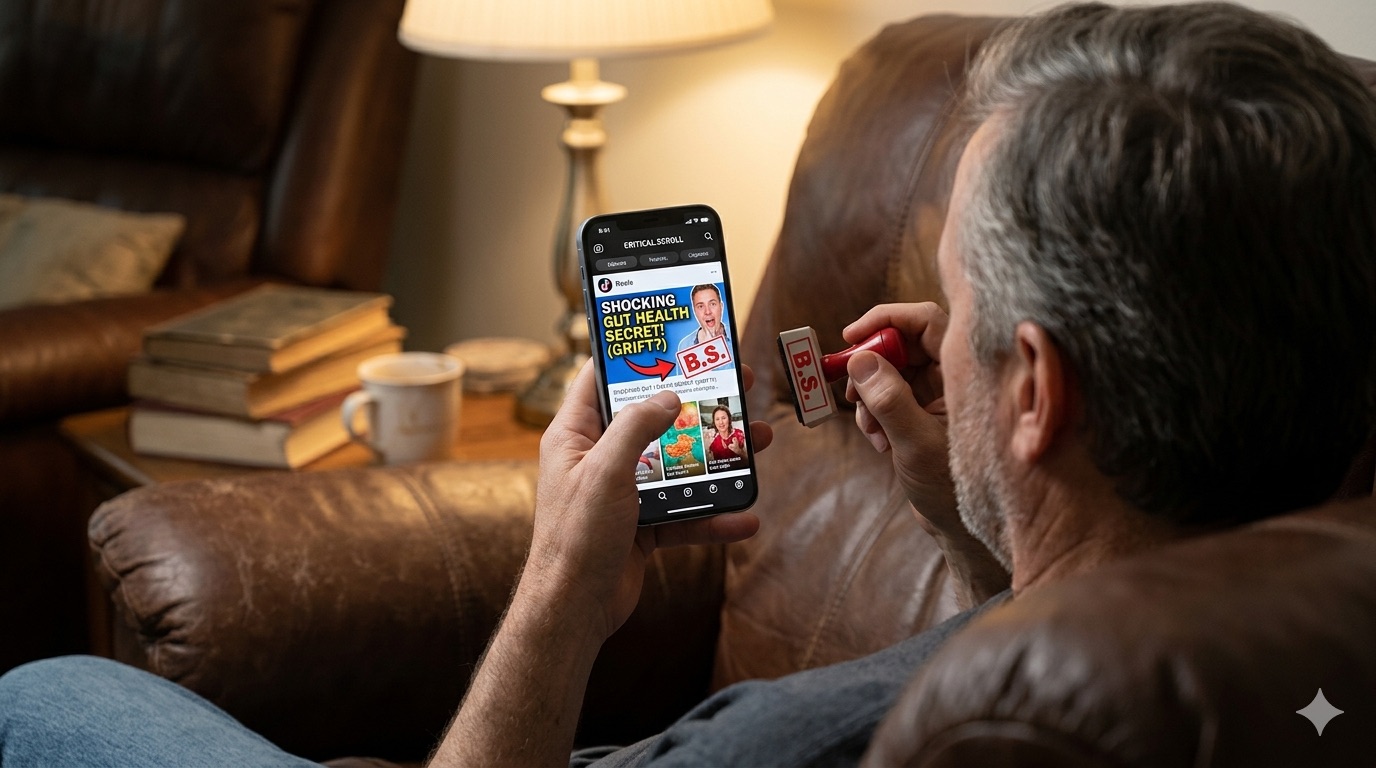
The Role of Critical Thinking in Combating Falsehoods

If you have spent more than five minutes on TikTok or Instagram Reels lately, you have probably noticed a pattern. Some guy in a rented kitchen is leaning into a microphone, whispering like he is sharing a state secret, telling you that “everything you know is a lie.” Usually, the “truth” involves you buying his PDF or clicking a link for a supplement made of dehydrated weeds.
We used to call this a “snake oil salesman.” Now, we call it a “content creator.”
The only way to survive this digital minefield without losing your mind—or your bank account—is critical thinking. But let us be clear: critical thinking is not just “being a hater.” It is the process of actively evaluating information instead of letting it wash over you like a bucket of warm nonsense [1].
The 60-Second Hijack
Short-form video is a precision-guided strike on your attention span. Research suggests that the constant “context switching” of scrolling through Reels actually reduces our ability to engage in “deep work” or long-term focus [2]. These platforms are designed to trigger your “System 1” thinking: the fast, intuitive, emotional part of your brain. They want to bypass “System 2,” which is the slower, more logical part that says, “Wait a minute, this guy is an idiot” [3].
When a video makes you feel suddenly terrified of your own tap water or outraged by a 15-second clip of a politician, that is not an accident. It is a business model.
The Economic Motive: Follow the Money
In my world, we always follow the money. Whether it is an influencer trying to sell you a “gut-healing” powder or the platform itself using “engagement algorithms” to keep you scrolling, someone is getting paid for your eyeballs.
A study from the University of Kansas found that the profit motivation of social media companies often compels them to prioritize polarized, biased content because it keeps people on the app longer [4]. If the video is free, you are not the customer. You are the product being sold to advertisers.
Applying the B.S. Filter
Applying critical thinking to your feed does not require a PhD. It just requires you to stop being a passive consumer.
- Check the “Persuasive Intent”: Is there a “link in bio” or a discount code? If so, you are watching a commercial, not a documentary [1].
- The “Pause and Breathe” Rule: Before you hit “share,” take ten seconds. Ask yourself: “Why did this video make me feel this way?” If a video is trying that hard to trigger an emotional response, it is usually because the facts would not be enough to get the click [5].
- Verify the Source: Does this person have actual credentials, or do they just have a ring light and a lot of confidence? A “verified” checkmark does not mean they are telling the truth. It just means they have eight dollars a month and a pulse [4].
The internet is a circus, and social media is the main tent. You do not have to be one of the clowns. Put the phone down, look at the world with your own eyes, and remember: if it sounds too “shocking” to be true, it is usually just a lie with a better marketing budget.