This isn't about being a cynic. It’s about being a skeptic.
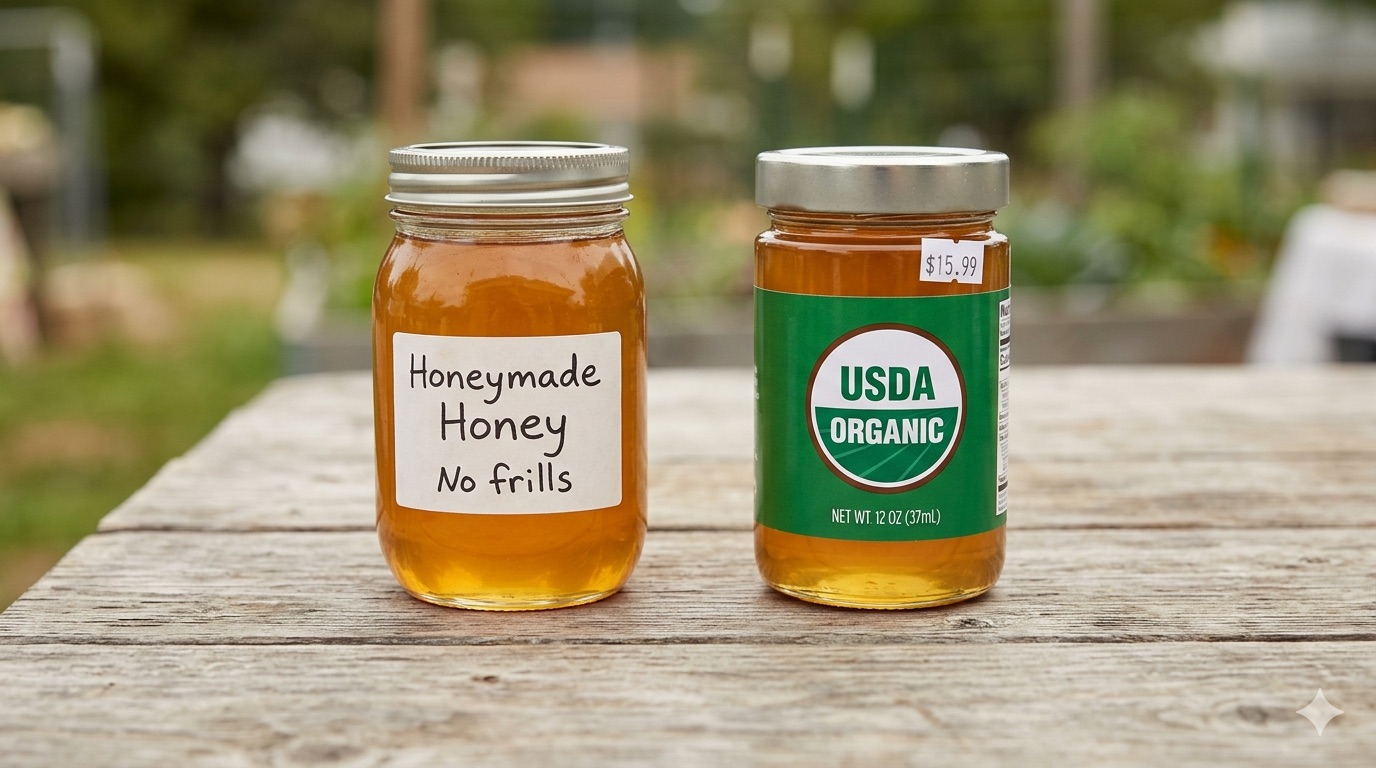
The Organic Honey Racket

There’s a jar of honey at your local grocery store with a green USDA Organic seal on the label. It costs about 40% more than the honey next to it. You grab it, because you’re trying to do the right thing, and you’ve been told organic means cleaner, purer, better. You take it home, drizzle it on your yogurt, and feel good about yourself.
Here’s what nobody told you: the USDA has never actually defined what “organic honey” means. Not once. Not ever. The standard doesn’t exist. You just paid a premium for a label that the federal government has never formally certified for any honey produced in the United States. 1
Enjoy your yogurt.
The Label That Means Nothing
Let’s back up. The USDA’s National Organic Program covers all kinds of agricultural products, but honey has always been a special case. The National Organic Standards Board drafted recommendations for organic apiculture back in 2010. Those recommendations were never finalized. As of 2025, the USDA has no binding federal standard for what makes honey organic. 2
So how are companies slapping a USDA Organic seal on jars of honey? Because the USDA allows third-party certifiers to do the job, and those certifiers are free to use whatever criteria they want, since there’s no official rulebook to follow. Some use European Union standards. Some use USDA livestock guidelines that were never intended for bees. Some use guidelines they essentially made up. All of them can legally print that green seal. 3
And here’s the kicker. If you’re a small producer selling less than five thousand dollars worth of honey a year, you don’t even need a certifier. You can call it organic and slap on the label yourself, with no inspection required. 4
Incredible. Truly.
Why Domestic “Organic” Honey Is Almost Impossible
Even if the USDA had a real standard, most American beekeepers couldn’t meet it. Here’s the problem: bees don’t read property lines.
A honeybee will fly up to four miles from her hive to forage. That means a single colony can cover more than 50 square miles of territory. For honey to be genuinely organic, every flower those bees visit needs to be free of pesticides and synthetic chemicals. That means no conventional farms, no treated lawns, no roadsides, no golf courses, no conventional orchards within a four-mile radius in every direction.
That’s not a farm. That’s a fantasy. 5
The few places in the U.S. where this is even theoretically possible, think isolated mountain valleys or deep national forest land, are producing tiny quantities of honey that never make it to supermarket shelves. Meanwhile, the American honey supply gap is enormous. In 2024, U.S. domestic production hit 134 million pounds, while consumption surged to well over 600 million pounds. Imports filled about 80% of that gap. 6
So where is all that organic honey on store shelves actually coming from?
Brazil. Mostly Brazil.
The organic honey in your pantry was almost certainly imported. 7 The country of origin certifies it as organic by their own standards, the U.S. accepts that foreign certification, and on the jar it goes. Brazil is the dominant source. Brazil has documented issues with regulatory oversight and food fraud. The U.S. doesn’t require independent retesting once the honey arrives.
To be fair, this isn’t exclusively a Brazil problem. It’s a system problem. The U.S. accepts organic certifications from dozens of countries, each with their own standards and their own levels of enforcement. We just trust the paperwork.
Back in 1990, the National Organic Program was created partly because the word “organic” had become a wild west of competing claims and marketing language with no uniform meaning. Thirty-five years later, for honey, we’re back in the same wild west. We just have a fancier seal now.
What You’re Actually Paying For
The organic honey market commands a 25% to 40% premium over conventional honey. 8 That’s real money on the table, and it’s built on a certification system that has no legal definition of what it’s certifying.
And it gets worse. The FDA conducted a sampling assignment of imported honey and found that 10% of samples tested between 2021 and 2022 were adulterated with undeclared sweeteners like corn or sugar beet syrup. They were labeled as honey. They weren’t entirely honey. 9 The FDA’s own testing methods can’t detect adulteration below about 20%, meaning a jar could be up to one-fifth cheap syrup and still pass inspection. 10
So you’re paying a 40% premium for “organic,” which isn’t legally defined, on a product where adulteration is a known and documented problem, and the testing isn’t sensitive enough to catch low-level fraud. The wellness industry would like you to know this is “mindful consumption.”
The Guy at the Farmers Market Is Probably Fine
Here’s the part that’s actually kind of maddening: the local beekeeper at your Saturday farmers market, the one with the hand-labeled jars and the sunburned forearms, probably can’t call his honey organic even if his hives are sitting in the middle of a pesticide-free nature preserve. Because without a certified-organic radius around the hive and formal paperwork through a certifying agency, he’s not allowed to make that claim. 11
So the system has produced this situation: a Brazilian importer can put a USDA Organic seal on a jar of honey certified by a foreign government using standards the USDA never approved, and you’ll pay a premium for it without a second thought. But an American beekeeper who actually knows every flower his bees visit can’t call it organic because he doesn’t have the right paperwork.
We have built a labeling system that rewards bureaucratic compliance and penalizes genuine small producers. The grift isn’t just the fake label. The grift is that the label was never real to begin with.
What to Actually Do
Buy local. Seriously. Find a beekeeper in your area, ask them what their practices are, and buy directly if you can. Raw, unfiltered honey from a local producer you can talk to is almost certainly a better product than a “certified organic” jar imported from 5,000 miles away and certified by a government whose standards you’ve never read.
The honey itself is fine. Honey has been fine since humans have been eating it. What isn’t fine is paying for a guarantee that nobody is actually making.
References
- The Truth About Organic Honey — Foxhound Bee Company
↩ - Almost All USDA Organic Honey is Imported: Not Produced in USA — Wendell Estate Honey
↩ - The Mystery Behind Organic Honey — Living Maxwell
↩ - Labeling Organic Products — USDA Agricultural Marketing Service
↩ - Organic Honey, Explained — Local Honey Finder
↩ - Q1 2025 Honey Market Report — Sweet Harvest Foods
↩ - The Truth About Organic Honey — Killer Bees Honey
↩ - Organic Honey Market to Reach $2.24B by 2033 — Mark Spark Solutions
↩ - FY21/22 Sample Collection and Analysis of Imported Honey for Economically Motivated Adulteration — FDA
↩ - Behind Closed Hives — The [F]law
↩ - The Truth About Organic Honey — Killer Bees Honey
↩