This isn't about being a cynic. It’s about being a skeptic.
We Have Done This Before

History doesn’t repeat itself. But it definitely plagiarizes itself.
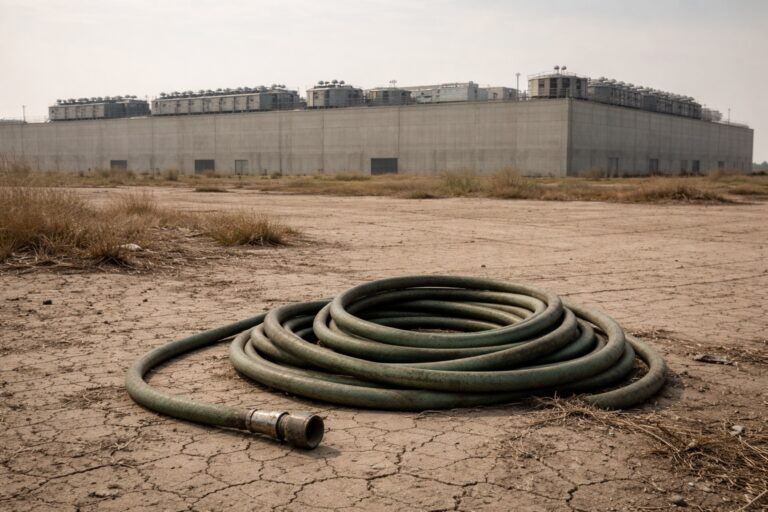
Right now, the United States is in the middle of a building frenzy unlike anything most people alive today have seen. The AI data center boom is pouring hundreds of billions of dollars into a physical infrastructure buildout that is reshaping land use, swallowing water, straining power grids, and hiking residential electricity bills. If you read the companion piece to this one, you already know what’s happening on the ground.
What I want to do here is pull back and look at the bigger picture. Because we have done this before. Not once. Several times. And each of those times left a record of who paid, who profited, and what got left behind. That record is worth reading before we decide how we feel about what’s happening now.
Round One: The Industrial Revolution (1760–1840)
When factory production exploded in Britain and spread to the United States, it was the fastest wealth-creation machine the world had ever seen. It was also completely unregulated. Factory owners ran 14- to 16-hour shifts, employed children as young as six in coal mines and textile mills, and dumped pollutants directly into rivers and air with no legal consequences.1 The people who built the factories got rich. The people who worked in them got sick, injured, and sometimes killed.
Regulation came eventually. But it lagged the technology by decades. Britain’s Factory Acts began in 1802 and tinkered at the margins for another 50 years.2 The United States didn’t pass meaningful federal child labor protections until 1938, nearly 150 years after the first American mills opened.3 The pattern was: build fast, externalize the costs onto workers and communities, fix it later if anyone makes enough noise.
That pattern sounds familiar. AI data centers are being built at a pace that has outrun environmental review processes, water rights frameworks, and local zoning norms. The profits are flowing to shareholders. The electricity bills are flowing to residents who didn’t ask for any of this.
The parallel isn’t perfect. Factory workers were directly employed in the dangerous conditions. Today’s affected communities are more like passive bystanders, paying higher power costs while the facilities operate largely without them. But the structural logic is the same: move fast, capture value, let someone else sort out the mess.
The Counterexample: Rural Electrification (1930s)
Before we get too fatalistic, it’s worth looking at the one time this country did a major infrastructure buildout the right way.
By 1935, about 90 percent of urban households had electricity. In rural America, the number was around 10 percent.4 Private power companies had done the math and decided rural areas weren’t worth the investment. So the Roosevelt administration created the Rural Electrification Administration (REA), which issued low-cost federal loans to nonprofit cooperatives. Those cooperatives then built distribution networks and connected rural communities to the grid at rates comparable to what urban customers were paying.5
Notice what was different. The investment was publicly accountable. The benefit was broadly distributed. The vehicle was a cooperative, not a corporation. And the explicit mandate was to close a gap that the private market had refused to close.
That’s the opposite of the current data center model, where private companies are extracting public resources (land, water, power grid capacity) and delivering benefits primarily to shareholders and enterprise customers. The REA counterexample doesn’t mean government always gets it right. But it proves that large-scale infrastructure investment can be designed around public benefit when there’s political will to do it. Right now, that will is largely absent.
Round Two: The Interstate Highway System (1950s–1970s)
The federal interstate system is one of the most consequential infrastructure projects in American history. It connected the country, enabled commerce, and made American suburbs possible. It also bulldozed hundreds of neighborhoods, disproportionately Black ones, without meaningful community input.
In St. Paul, Minnesota, the construction of I-94 displaced at least 650 families and demolished the core of the Rondo neighborhood, a thriving Black community that had existed since the late 1800s.6 Milwaukee, Pittsburgh, and dozens of other cities saw the same pattern: routes were drawn through low-income and minority neighborhoods because land was cheaper and political resistance was weaker.7 Communities were informed after the decisions were made, not before.
Now look at how AI data center siting is working in 2024 and 2025. In Wisconsin, at least four municipalities signed nondisclosure agreements with tech companies before any public announcement. In Beaver Dam, city officials quietly voted to create a tax increment finance district for a data center project whose developer was still identified only by a shell company. Residents weren’t told until 14 months after the NDA was signed.8 In Pine Island, Minnesota, a resident told a legislative committee that city officials had known about a planned Google data center for two years before the community was informed.9 In Tucson, county supervisors approved a facility known internally only as “Project Blue” before learning it was an Amazon Web Services installation.10
The interstate highway system used eminent domain and federal mandate to lock out communities. The data center boom uses NDAs and shell companies. Different tools, same result: decisions made over people’s heads, presented as facts on the ground.
Round Three: The Railroad Boom (1860s–1880s)
This one has some real bubble energy worth paying attention to.
Between the 1860s and 1880s, the United States built rail lines at a ferocious pace, fueled by federal land grants, speculative investment, and the kind of enthusiasm that makes smart people do dumb things with money. The Northern Pacific Railway alone received 40 million acres of federal land.11 Companies financed expansion through bonds, assuming future profits would cover the debt. Many built lines into territory that couldn’t support the traffic volumes they projected.
The ecological cost was staggering. The transcontinental railroad split the Great Plains bison herds into northern and southern populations, and then enabled industrial-scale hunting that reduced a population of an estimated 30 to 60 million animals to near extinction by the end of the century.12 The habitat destruction was irreversible and deliberate. Bison were being eliminated to clear land and eliminate a food source that Indigenous nations depended on.
The financial collapse came in 1893. Railroads had been overbuilt. The speculative lines couldn’t generate the revenues that bond issuers had promised. When confidence broke, it broke fast: over 15,000 companies and 500 banks failed, and unemployment in some states climbed above 25 percent.13
Now look at the current numbers. The 14 largest publicly owned data center operators are projected to spend close to $750 billion in 2026 alone, up from roughly $450 billion the year before.14 Analysts at Ares Management and others have flagged overcapacity risks. Investment firm analysts have noted that when suppliers invest in startups that then spend that money on the supplier’s own products, it becomes very difficult to distinguish genuine demand from manufactured demand.15 Some analysts were already noting in early 2025 that Microsoft had begun canceling data center leases and Amazon had paused certain discussions.
None of that means the whole thing collapses tomorrow. The underlying technology is real, unlike some other bubbles. But the railroad comparison is instructive: real technology, genuine long-term value, and still capable of a catastrophic overbuilding cycle followed by a painful correction. The people who built the Great Northern Railway without subsidies survived. The people who bet borrowed money on the Northern Pacific and the Atchison, Topeka and Santa Fe did not.
What History Is Actually Saying
The honest read across all four of these comparisons is not “AI data centers are doomed” and it’s not “this is fine.” It’s more nuanced than either.
The Industrial Revolution precedent says: expect regulation to lag badly, expect communities to bear costs they didn’t agree to, and expect the cleanup to take longer than the buildout.
The Rural Electrification counterexample says: infrastructure at this scale doesn’t have to work this way. It’s a policy choice, not a law of nature.
The interstate precedent says: when communities are locked out of decisions via legal instruments, the damage tends to be concentrated on whoever had the least political power to object. That pattern is already repeating.
The railroad precedent says: speculative infrastructure booms powered by debt and circular investment have a specific shape. We know what that shape looks like. Whether this one ends the same way depends on whether demand for AI compute is as durable as the railroads’ boosters believed passenger volumes would be in 1885.
History doesn’t make predictions. But it does have opinions. And right now, it is giving this situation a fairly skeptical look.
References
- The Rise of the Machines: Pros and Cons of the Industrial Revolution ↩
- Factory Act | EBSCO Research Starters ↩
- Child Labor During the Industrial Revolution in America ↩
- Rural Electrification Act | New Georgia Encyclopedia ↩
- Rural Electrification Administration | EH.net ↩
- Rondo Neighborhood | Wikipedia ↩
- Freeway Removal | Wikipedia ↩
- At Least Four Wisconsin Communities Signed Secrecy Deals for Billion-Dollar Data Centers | Wisconsin Watch ↩
- Data Centers and the Abuse of Secrecy | Governing ↩
- How to Rein in Big Tech’s Secret Data Center Deals | American Economic Liberties Project ↩
- Railroad Land Grants in the United States | Wikipedia ↩
- Where the Buffalo No Longer Roamed | Smithsonian Magazine ↩
- Panic of 1893 | Saylor Academy ↩
- AI Data Center Build Advances at Full Speed | BloombergNEF ↩
- Where AI Data Centers Are Headed After 2025’s Boom | Built In ↩