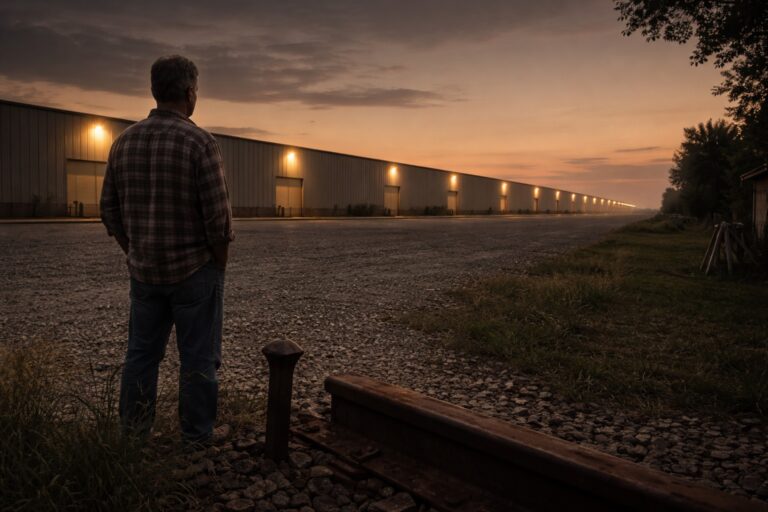
This isn't about being a cynic. It’s about being a skeptic.
The Data Center Tab

Back in the day, if you wanted to build something that sucked up the resources of a small city, someone would notice. Permits. Hearings. Neighbors with lawn signs. Now, they just call it a “campus,” put up a fence around a cornfield, and tell the local paper it’s going to create jobs. And technically, they’re not wrong. It’s just that the jobs are mostly construction, the pay is mostly for the first few years, and the tab for everything else goes directly to you.
AI data centers are the infrastructure behind every chatbot, image generator, and algorithmic recommendation you’ve touched in the last few years. And the costs. The water. The power. The noise. The land. Most of it doesn’t make it into the press release.
Here’s what the numbers actually say.
The Water Problem
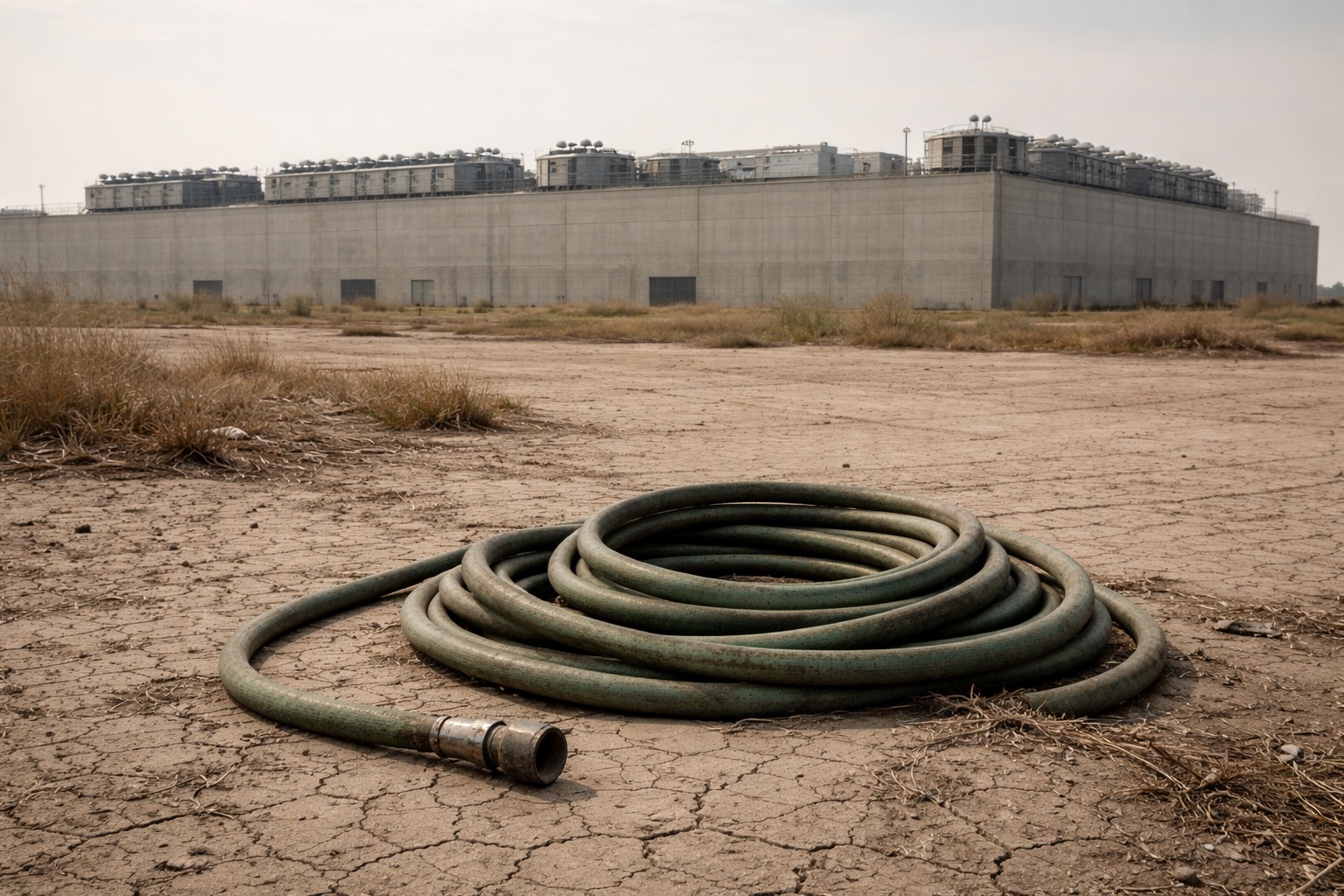
Data centers run hot. Servers generate enormous amounts of heat, and the standard way to deal with that heat is to pump water through cooling systems and let it evaporate. It works the same way sweating works, except instead of one human body, you’re cooling a warehouse the size of several football fields, around the clock, every day of the year.
A typical data center uses around 300,000 gallons of water per day. That’s the equivalent of roughly 1,000 households. Large hyperscale facilities can use up to 5 million gallons per day, on par with a town of 50,000 people. 1 As of 2021, U.S. data centers collectively consumed about 163.7 billion gallons of water annually, and the number has kept climbing since then. 2
Google’s data centers consumed 6.1 billion gallons in 2024 alone, up from 4.3 billion in 2021. 3 One Meta facility in Newton County, Georgia, drinks 500,000 gallons per day, which is about 10% of the entire county’s water supply. 4
Here’s the part that should make anyone in a dry state pay attention: a 2025 Bloomberg report found that about two-thirds of data centers built or under construction since 2022 are located in regions already experiencing high water stress. 5 The IEA projects that by 2027, accelerated AI adoption alone could result in an additional 4.2 to 6.6 billion cubic meters of water withdrawal globally. 6 A study from the Houston Advanced Research Center projects that data centers in Texas alone could consume up to 399 billion gallons of water per year by 2030. 7
The water doesn’t come back. Most of it evaporates into the air and is not returned to local watersheds. Aquifers get drawn down. Stream flows drop. Water temperatures rise in nearby waterways, which can devastate cold-water species that need clean, cool water to survive. 5
But Wait: The Closed-Loop Argument
If you’ve been reading about this issue online, you’ve probably seen some pushback along the lines of “new data centers use closed-loop cooling systems that don’t consume water the same way.” That’s not wrong. But the full picture is a bit more complicated.
In August 2024, Microsoft began deploying a new closed-loop, chip-level cooling system that eliminates the need for evaporative water. Once filled during construction, the system recirculates coolant without requiring additional water input, saving more than 125 million liters per facility annually. 8 Closed-loop systems in general can reduce water usage by roughly 90% compared to traditional evaporative cooling. 9
That’s legitimately good news. The problem is that closed-loop systems are primarily being deployed in new construction, and the vast majority of the world’s existing data centers still run on old evaporative cooling. The efficiency gains are real. They’re just not yet widespread. And as AI workloads intensify, the demand for cooling is increasing faster than the industry is retrofitting its old buildings. Rack power density is expected to grow from 36 kW in 2023 to 50 kW by 2027, with next-generation AI chip clusters potentially hitting 600 kW per rack. 10 More heat means more cooling pressure, even for the newer systems.
So yes: the closed-loop technology is real, it works, and it matters. Whether it scales fast enough to offset the growth in demand is a different question.
The Power Bill
The energy story is the one that most people have started to hear about, even if they’re not clear on the scale.
U.S. data centers consumed 183 terawatt-hours of electricity in 2024. That’s more than 4% of the country’s total electricity consumption for the year, and it’s roughly equivalent to the annual electricity demand of the entire nation of Pakistan. 11 Globally, data centers used around 415 TWh in 2024, or about 1.5% of all electricity on earth. The IEA projects that figure to more than double to 945 TWh by 2030. 12
A single AI-focused query uses roughly 0.3 watt-hours of electricity, compared to about 0.0003 kWh for a standard Google search. That’s approximately 1,000 times the energy per interaction. 13 A single large AI model training run can require tens of megawatts of power sustained over weeks or months.
To understand what this growth actually looks like at the grid level: in July 2024, a voltage fluctuation in northern Virginia triggered the simultaneous disconnection of 60 data centers, producing a 1,500-megawatt power surplus and forcing emergency grid adjustments to prevent cascading outages. 14 Northern Virginia is home to approximately 4,000 MW of data center capacity, the largest concentration of data center infrastructure in the world. 13 Ireland, for comparison, now has data centers consuming 22% of the country’s total national electricity output. 13
The carbon footprint of all this power is significant. A 2024 study examining 2,132 U.S. data centers found that they accounted for more than 4% of U.S. electricity consumption, with 56% of that electricity derived from fossil fuels, generating more than 105 million tons of CO2 equivalent. Their carbon intensity exceeded the U.S. average by 48%. 15 The IEA estimates that global data center CO2 emissions will peak around 320 million metric tons by 2030 before a gradual decline, assuming clean energy adoption continues on its current trajectory. 16 That “assuming” is doing a lot of work in that sentence.
To meet growing demand, utilities are delaying the retirement of fossil fuel power plants, and proposals to revive retired plants have increased. Gas-fired power generation for data centers is projected to more than double between 2024 and 2035. 17
Your Electric Bill
Here’s where it stops being an abstract environmental story and starts being a direct hit to your checking account.
Average U.S. electricity prices reached 19 cents per kWh by the end of 2025, up about 27% from 2019. In states with high data center concentrations, the increases have been sharper. In Virginia, electricity prices have risen by up to 267% over the last five years. 18 A Carnegie Mellon University study estimates that data centers and cryptocurrency mining could lead to an 8% increase in the average U.S. electricity bill by 2030, potentially exceeding 25% in the highest-demand markets. 11
In the PJM electricity market, which runs from Illinois to North Carolina, data centers accounted for an estimated $9.3 billion price increase in the 2025–26 capacity market, which is expected to add roughly $16 to $18 per month to residential bills in affected areas. 11 One advocacy group summed it up plainly: without data centers, Virginia’s electricity consumption would be largely flat. The infrastructure buildout being charged to residential customers exists almost entirely to serve these facilities. 19
In late 2025, Virginia’s State Corporation Commission approved new rate increases for Dominion Energy and created a new rate class specifically for large power users like data centers, effective January 2027. The stated goal is to prevent data center costs from being passed entirely onto residential customers. Whether that happens in practice remains to be seen. 20
The Noise and the Land
There are two more impacts that get less coverage than water and power, but that are very real for anyone living near one of these facilities.
Noise. A large data center runs cooling fans, HVAC systems, and diesel backup generators around the clock. Noise levels inside a data center can reach 96 decibels. Industrial diesel generators can hit 105 decibels during testing, about as loud as a jet flying overhead. 21 Low-frequency hum from cooling systems is a particular problem because it can’t be blocked with standard sound barriers, travels through walls, and doesn’t register on standard decibel meters in a way that captures how residents actually experience it.
In Chandler, Arizona, residents near a data center complained for years about a constant hum that never stopped, including at night. Noise-canceling headphones and earplugs didn’t fix it. After nearly a decade of resident complaints, the city amended its zoning code to make it harder to site data centers there, and in 2025, the city council unanimously voted against a new proposed facility. 21 In Prince William County, Virginia, residents reported noise levels routinely exceeding 60 decibels from nearby data centers located, in some cases, within 200 feet of residentially zoned properties. 21 Noise also affects wildlife: it disrupts communication, navigation, and breeding patterns, and can push animals out of their established corridors. 22
Land. As of 2024, the average data center land transaction covered 224 acres, a 144% increase since 2022. Large hyperscale campuses frequently require 500 acres or more. 23 That land comes from somewhere: farmland, wetlands, forests, and other habitats. In Alabama, environmental groups raised concerns that a proposed data center could wipe out the federally threatened spring pygmy sunfish by altering and depleting its spring-fed habitat. 5 Wetland loss from development increases flooding and degrades water quality for communities downstream. Transmission line expansion to power remote data centers fragments migration corridors and can alter animal behavior even without direct habitat destruction. 24
What This Actually Is
None of this is an argument that data centers shouldn’t exist. They’re real infrastructure that does real things. But the “it’s complicated” framing that gets used to dismiss legitimate concerns is itself worth examining.
The technology is advancing. Closed-loop cooling is a genuine improvement. Renewable energy commitments from major tech companies are real, even if the pace of adoption is slower than the marketing suggests. Some of the worst-case projections assume no further efficiency gains, which isn’t realistic.
But here’s what’s also true: more than $64 billion in data center projects were delayed or canceled between May 2024 and March 2025 due to organized community opposition. 25 In 2025, local opposition led to the delay or cancellation of projects totaling $156 billion. 26 A Virginia JLARC report commissioned by the state legislature in 2024 described an industry that “isn’t sustainable” and is “undermining Virginia’s climate goals.” 27 Many developers have entered non-disclosure agreements with local governments, limiting what residents can legally be told about the scale, resource demands, and potential impacts of projects in their own backyards. 25
In other words, people who are raising questions about this stuff aren’t being paranoid. They’re reading the data.
The bill is real. It just gets delivered quietly.
References
- AI, data centers, and water — Brookings Institution ↩
- Data Centers and Water Consumption — Environmental and Energy Study Institute (EESI) ↩
- Data Center Water Use — MOST Policy Initiative ↩
- Data Centers Now Drink More Water Than Entire Cities — Sentinel Earth ↩
- Data Centers 101 — National Wildlife Federation Blog ↩
- What New Water Circularity Can Look Like for Data Centres — World Economic Forum ↩
- Data Drain: The Land and Water Impacts of the AI Boom — Lincoln Institute of Land Policy ↩
- Sustainable by Design: Next-Generation Datacenters Consume Zero Water for Cooling — Microsoft ↩
- Cooling Without the Drain: How Closed-Loop Systems Cut Day-to-Day Water Use — Vantage Data Centers ↩
- How AI Growth Is Intensifying Data Center Water Consumption — Net Zero Insights ↩
- What We Know About Energy Use at U.S. Data Centers — Pew Research Center ↩
- Energy Supply for AI — International Energy Agency ↩
- How Much Electricity Does a Data Center Use? Complete 2025 Analysis — IAEI Magazine ↩
- AI, Data Centers, and the U.S. Electric Grid: A Watershed Moment — Harvard Belfer Center ↩
- Environmental Burden of United States Data Centers in the Artificial Intelligence Era — arXiv (UC Riverside / Caltech) ↩
- Energy and AI: CO2 Emissions Projections — International Energy Agency ↩
- AI: Five Charts That Put Data Centre Energy Use and Emissions Into Context — Carbon Brief ↩
- Data Center Power Demands Are Contributing to Higher Energy Bills — EESI ↩
- Rate Hike: Dominion Energy Points to Inflation While Others Blame Data Centers — WTVR ↩
- SCC Issues Order on DEV Biennial Review 2025 — Virginia State Corporation Commission ↩
- Communities Are Raising Noise Pollution Concerns About Data Centers — EESI ↩
- Understanding the Impact of Data Center Noise Pollution — TechTarget ↩
- The Increasing Concern of Data Center Land Acquisition — TechTarget ↩
- Data Centers Are Stress-Testing the Grid: Communities and Wildlife Are Feeling the Pressure — NWF Blog ↩
- From Energy Use to Air Quality, the Many Ways Data Centers Affect U.S. Communities — World Resources Institute ↩
- Opposition to AI Data Centers — Wikipedia ↩
- The Dark Side of Data Centers — Loudoun Climate Project ↩