This isn't about being a cynic. It’s about being a skeptic.
The Self-Diagnosis Industrial Complex

My kid came home from school last year and told me she was pretty sure she had ADHD. She had seen a video about it. Actually, she had seen a lot of videos about it. The algorithm had decided that ADHD content was her content, and now every twitch and distraction and bad test score had a name, a community, and a product recommendation attached to it.
I didn’t laugh at her. I asked questions. And the more she talked, the more I realized this wasn’t really about her brain. It was about a machine that had figured out how to turn normal human experience into a diagnosis, and then turn that diagnosis into a sale.
The Numbers Don’t Add Up
Here’s where it gets interesting. A 2024 survey found that roughly one in four American adults believes they have ADHD.1 The actual clinical prevalence is somewhere between one in 15 and one in 17.2 That’s not a small gap. That’s a canyon.
A 2025 study out of the University of British Columbia looked at the top 100 videos tagged #ADHD on TikTok. Clinical psychologists evaluated the claims. Fewer than half of the symptom claims in those videos actually aligned with the diagnostic criteria in the DSM-5.3 The same study found that young adults who regularly watched ADHD content on TikTok were significantly more likely to overestimate how common and how disabling the condition is.3
That hashtag has racked up billions of views. Nearly half a billion on the top 100 videos alone.
What’s Actually Being Sold
Let me be clear about something. ADHD is real. It affects real people and it causes real problems. Some folks went years without a diagnosis and genuinely struggled. That part of the conversation matters.
But the version of ADHD that lives on TikTok isn’t the clinical version. It’s a lifestyle brand.
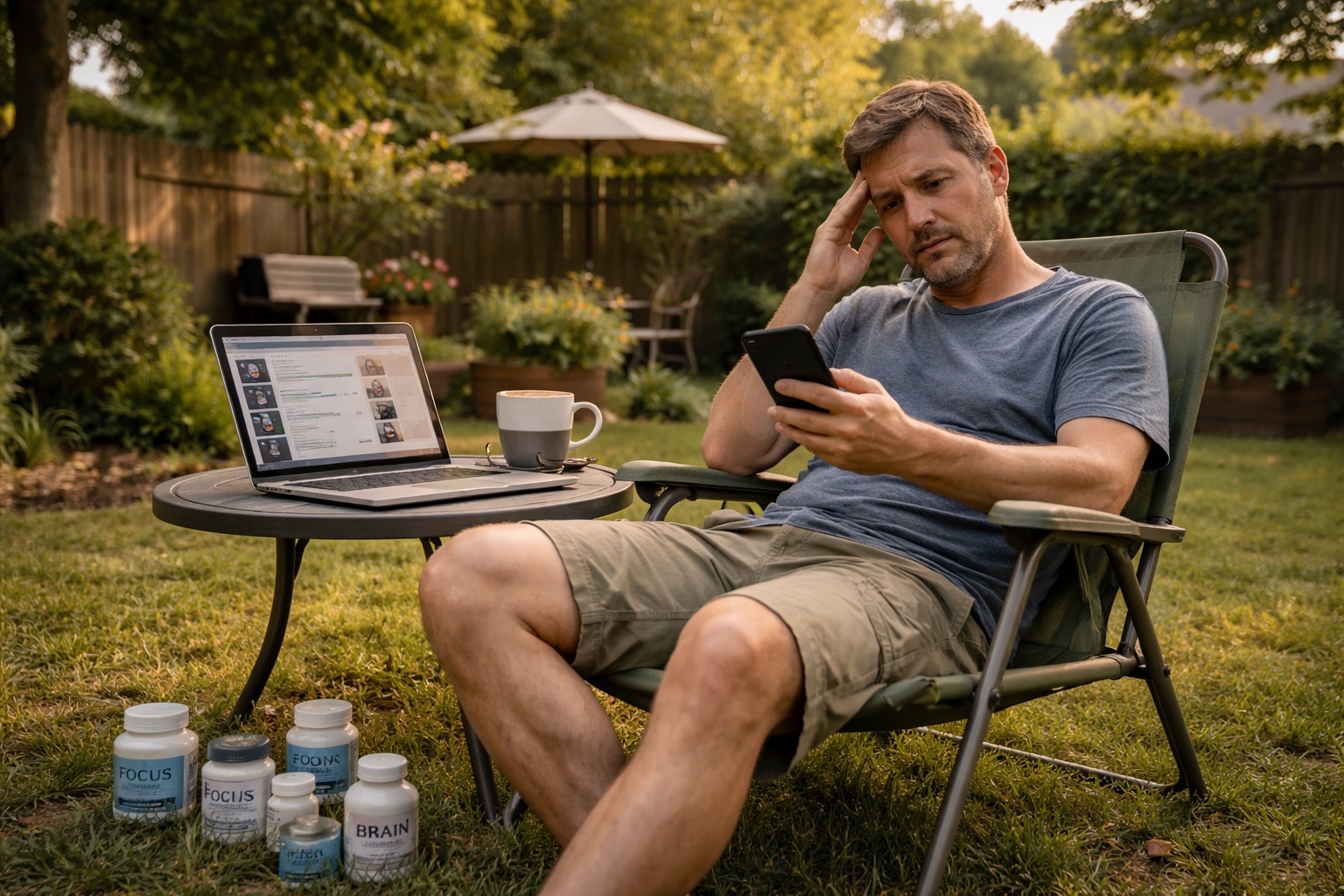
The content follows a familiar pattern. Someone relatable describes forgetting to reply to texts, losing their keys, getting bored in meetings, and feeling overwhelmed by their inbox. The comments light up. Thousands of people say “this is literally me.” The creator links to a focus supplement in their bio. Or a course. Or a coaching program.
The “brain health” supplement market in the US alone was valued at over $3.5 billion in 2024 and is projected to nearly double by 2030.4 The segment they call “attention and focus” is one of the fastest growing slices of it.5 None of those supplements require FDA approval. None of them have to prove they work before hitting the shelf.
You lost your keys this morning. That’s $49.99, please.
The Algorithm Is the Engine
Back when I was a kid, if you thought something was wrong with you, you had to go find a doctor and sit in a waiting room for three hours to find out. The friction was annoying, but it also gave you a cooling-off period. You had time to wonder if maybe you were just tired.
The algorithm doesn’t give you that. It notices you watched a 45-second video about ADHD all the way to the end. So it shows you another one. And another. Each one a little more specific, a little more targeted, a little more convinced that you definitely have this thing.
Researchers who study virality on these platforms have found that the more views a piece of health content has, the more credible people perceive it to be, regardless of its accuracy.6 Popularity gets mistaken for authority. The result is that the most misleading health videos often spread furthest, because the algorithm rewards engagement and engagement rewards emotion.
What Happens Next Isn’t Great
Here’s the part that actually matters. When someone who doesn’t have ADHD gets convinced they do and eventually sees a doctor, there’s a real risk. Stimulant medications improve focus and mood in people without ADHD too.2 So the patient feels better, the doctor thinks the diagnosis is confirmed, and someone ends up on medication they don’t need. Meanwhile, the waiting lists for actual evaluations get longer. The people who genuinely need help wait more.
And a lot of people never see a doctor at all. They just accept the TikTok verdict and start self-medicating with whatever supplement the creator in the video was kind enough to recommend.
The Grift, Not the Grief
I want to say this again because it matters: I’m not mocking anyone who has watched those videos and felt seen. Mental health content online can do real good. It reduces stigma. It helps people who’ve been silently struggling realize they’re not alone and that there might be a name for what they’re going through.
The problem isn’t awareness. The problem is that awareness is being manufactured and monetized by people who have a financial interest in making sure you feel like something is wrong with you.
The creators who do this well aren’t villains. They’re just people who figured out that the algorithm pays better when their audience has a condition than when it doesn’t. So the symptoms get broader. The bar for self-identification gets lower. And the supplement link stays right there in the bio, refreshed every season with whatever the new thing is.
My kid, for what it’s worth, talked to her actual doctor. Turns out she was stressed about school and not sleeping enough. We worked on that. It helped.
The internet will not be sending her a refund.
References
- Healio: Misinformation on TikTok can lead to misunderstanding of ADHD, inaccurate self-diagnosis (2025) ↩
- PMC: Commentary on Sources of Attention-Deficit/Hyperactivity Overdiagnosis Among U.S. Adults (2025) ↩
- PLOS ONE: A double-edged hashtag: Evaluation of #ADHD-related TikTok content and its associations with perceptions of ADHD (2025) ↩
- Grand View Research: U.S. Brain Health Supplements Market Report (2024) ↩
- Coherent Market Insights: United States Brain Health Supplements Market (2025) ↩
- Journal of Advertising & Marketing Communications: Going Viral: Sharing of Misinformation by Social Media Influencers (2025) ↩