This isn't about being a cynic. It’s about being a skeptic.
The Sour Truth: Is Your Citric Acid a Lemon or a Lab Project?

Pick up almost any bottle, can, or carton in your kitchen right now and there is a good chance you will find citric acid in the ingredients list. Pasta sauce, soda, energy drinks, vitamins, canned tomatoes, salad dressing. Most people assume somebody somewhere is squeezing lemons into a vat.
Nobody is squeezing any lemons. The citric acid in your food almost certainly came from a fungus.
How It’s Actually Made
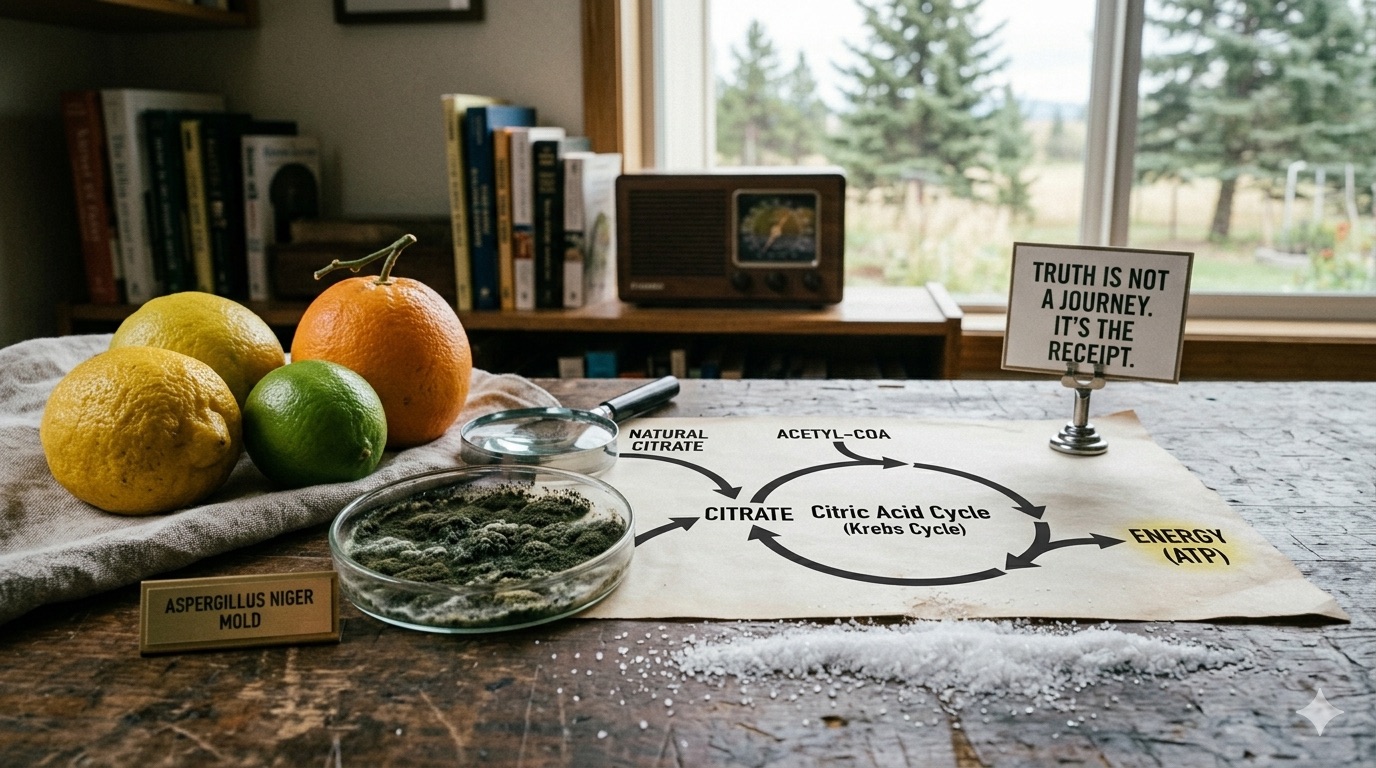
In 1917, an American food chemist named James Currie discovered that a common black mold called Aspergillus niger could produce citric acid when fed sugar. By 1919, the process was being used commercially, and it has been the industry standard ever since. [1]
The process works like this: Aspergillus niger is fed a carbohydrate substrate, usually corn-derived glucose or beet sugar, in large fermentation tanks. The mold digests the sugar and excretes citric acid as a byproduct. That acid is then filtered, purified, and crystallized into the white powder you see listed in ingredients. Today, roughly 99 percent of the world’s manufactured citric acid (MCA) is produced this way, predominantly in China. In 2016 alone, 2.3 million tons of it were produced. [1]
The label just says “citric acid.” It does not say “produced by black mold fermentation.” Most people have no idea.
The Molecular Truth and Why It Gets Complicated
Here is where it gets interesting, and where the internet tends to take a hard left turn into either total dismissal or full panic.
On a strictly molecular level, the citric acid produced by Aspergillus niger is chemically identical to the citric acid in a lemon. Same formula: C6H8O7. Your body’s Krebs cycle, the cellular process that converts food to energy, processes both exactly the same way. [2]
The question isn’t the molecule. The question is what else might come along for the ride.
A 2018 study published in Toxicology Reports documented four cases in which individuals reported significant inflammatory reactions, including joint pain, muscle pain, respiratory issues, and digestive distress, after consuming foods and beverages containing manufactured citric acid, but not after consuming natural citrus. The researchers hypothesized that trace proteins or byproducts from the Aspergillus niger fermentation process might survive the purification and trigger responses in people sensitive to mold. To their credit, the authors were careful to state that four case reports cannot conclusively prove MCA caused the symptoms. They called for proper controlled studies to determine whether a genuine risk exists. [1]
Those studies still haven’t happened. That is the more unsettling part of this story.
The Regulatory Gap
MCA got its “Generally Recognized As Safe” (GRAS) designation from the FDA not because it was tested, but because it was already in widespread use before the Food Additives Amendment of 1958 kicked in. Congress carved out a grandfather clause for ingredients with a history of prior use. MCA qualified. No modern safety evaluation was required. [3]
That does not mean it is dangerous. A century of widespread consumption without a documented public health crisis is meaningful evidence. But the 2018 researchers were not wrong to point out that no long-term studies on chronic exposure exist, and that the regulatory approval was based on common use rather than clinical evaluation. For an additive that is now in an extraordinary percentage of processed food, that is a legitimate gap worth knowing about.
Who Should Actually Pay Attention
For the vast majority of people, MCA is not a problem. The science does not support treating it as a general public health threat, and anyone telling you otherwise is likely selling you something. But there are two groups for whom this information is genuinely useful.
First, people with known mold sensitivities or allergies. Aspergillus niger is a documented allergen. If you react to mold in other contexts and have unexplained symptoms that correlate with processed food consumption, MCA is a reasonable thing to investigate with an actual doctor, not a content creator.
Second, anyone who wants to understand what is actually in their food. The fact that “citric acid” on a label conjures images of lemons while actually describing the output of an industrial fungus fermentation process is a reasonable transparency complaint. Not a health crisis, but a legitimate reason to read labels with a more skeptical eye.
Bob’s Take
Is MCA going to kill you? No. Is it a shadowy poison cooked up by Big Food to keep you weak and docile? Also no.
What it is, is a century-old industrial shortcut that has never been rigorously evaluated for chronic exposure, is in almost everything you eat and drink, and is labeled in a way that obscures what it actually is. That is not a conspiracy. It is just the food industry doing what the food industry does: finding the cheapest route to the result and letting the regulatory grandfather clause do the rest.
If you have a known mold sensitivity and mysterious symptoms, talk to your doctor and check your labels. If you don’t, eat your pasta sauce and stop worrying about it.
And if you want citric acid from an actual lemon, buy a lemon. Fifty cents. No fermentation tank required.