This isn't about being a cynic. It’s about being a skeptic.
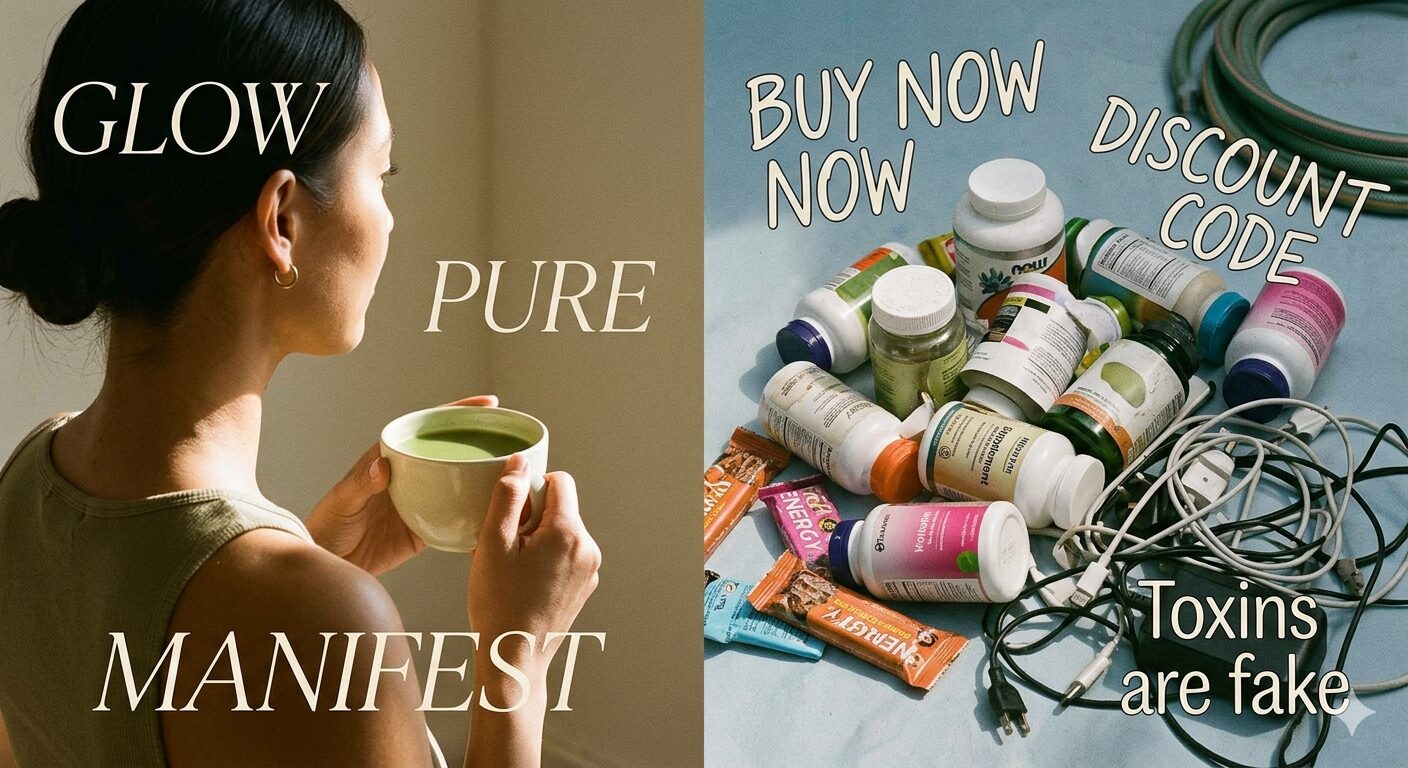
The Wellness Grift

The wellness industry is worth $6.8 trillion. Let that land for a second. That’s trillion, with a T, which makes it roughly four times larger than the entire global pharmaceutical industry. It has doubled in size since 2013 and is on pace to hit $10 trillion by 2029. For context, that’s bigger than global tourism, bigger than IT, and bigger than the entire green economy. [1]
And a significant chunk of that money flows directly through the phones of people who aren’t doctors, aren’t nutritionists, and aren’t required by law to prove a single thing they tell you.
I’m not here to tell you that wellness is a scam. Eating well, moving your body, getting enough sleep, and managing stress are genuinely good ideas. They were good ideas before Instagram existed, and they’ll be good ideas long after the algorithm decides that whatever comes after TikTok is the new thing. The problem isn’t wellness. The problem is what the industry built around it.
The Parasocial Doctor’s Office
Back when I was growing up, if you wanted health advice, you either called a doctor or asked your grandmother. Both options came with actual accountability. One had a medical license on the line. The other had a wooden spoon.
Now, research shows that nearly 6 in 10 people under 35 use social media as a primary source of health information. Meanwhile, only about 5 percent of them report being very knowledgeable about how to evaluate health research. That’s a gap you could drive a supplement-filled semi-truck through. [2]
Wellness influencers fill that gap because they’re good at one specific thing: making you feel like they know you. Researchers call it a parasocial relationship. You watch someone’s videos every day, they talk directly into the camera, they share their “journey,” and your brain starts treating them like a friend. A trusted friend. One who just happens to have a discount code.
The trust isn’t accidental. It’s the product. And the science on how it works is not subtle. Studies have found that people are more likely to believe health claims from influencers they find physically attractive or relatable, regardless of whether those influencers have any actual training. The credibility is borrowed. The product is real. And the money is very, very real. [2]
What They’re Actually Selling
Here’s the part that doesn’t get said enough: the FTC requires influencers to disclose when they’re being paid to promote something. The agency has levied fines, sent warning letters to hundreds of companies, and in one notable case, extracted $930,000 in consumer refunds from a supplement brand whose influencers made health claims they couldn’t back up with science. [3]
And yet, a 2025 study found that more than 80 percent of wellness influencers on TikTok failed to disclose conflicts of interest in their content. The same study found that diet and weight loss content was the least likely category to be accurate. The rules exist. The enforcement exists. The violations keep happening anyway, because the math still works out in their favor. [4]
That same research found that on TikTok, only 4 to 5 percent of the health and nutrition content users actually see comes from credentialed experts. The rest is coming from people who woke up one morning, bought a ring light, and decided they had something to say about your cortisol levels. [4]
Why It Works
Here’s the part where I want to be direct, because this isn’t about intelligence. People who are smart, educated, and thoughtful get taken in by this stuff all the time. The system is designed to exploit how human brains actually work.
Psychologists call one piece of it the “mere exposure effect.” The more you see something repeated, the more familiar it feels, and the more familiar something feels, the more believable it becomes. A wellness influencer doesn’t need to convince you in one video. They need to show up in your feed every day for six months, and eventually, the claim starts to feel like common sense. [5]
There’s also the emotional hook. UC Davis psychologist Camelia Hostinar has pointed out that information making people feel hopeful or optimistic spreads easily, even when it isn’t accurate. A claim like “you can heal your gut just by cutting out this one food” isn’t just a product pitch. It’s a small piece of hope handed to someone who might be exhausted, frustrated, or in real pain. That’s not stupidity. That’s being human. [5]
What You Can Actually Do
When you see a health claim online, ask three questions. First: is this person a credentialed expert in the field they’re speaking about? Not a self-described wellness coach, not someone who “studied nutrition,” but an actual licensed professional with accountable credentials. Second: is there a product attached to this claim? If someone tells you that you have a problem and immediately offers to sell you the solution, that’s a sales pitch, not health advice. Third: can this claim be found in peer-reviewed research, or is the only evidence a testimonial from someone who says it worked for them?
The wellness industry isn’t going anywhere. And not everything in it is garbage. But the loudest voices in that space are often the ones with the least accountability and the most to sell. A good doctor doesn’t need a discount code. A good nutritionist doesn’t need a ring light.
Your health is worth more than someone’s conversion rate.
References
- Global Wellness Institute: Statistics and Facts ↩
- Social Media Influencers and Health Misinformation: Why We Must Be Cautious ↩
- FTC Disclosure Rules for Influencers↩
- The Perils of Wellness Content on Social Media Sites, Psychology Today↩
- Debunking Wellness Myths: How to Identify and Combat Health Misinformation, UC Davis Health↩