This isn't about being a cynic. It’s about being a skeptic.
The Carnivore Grift

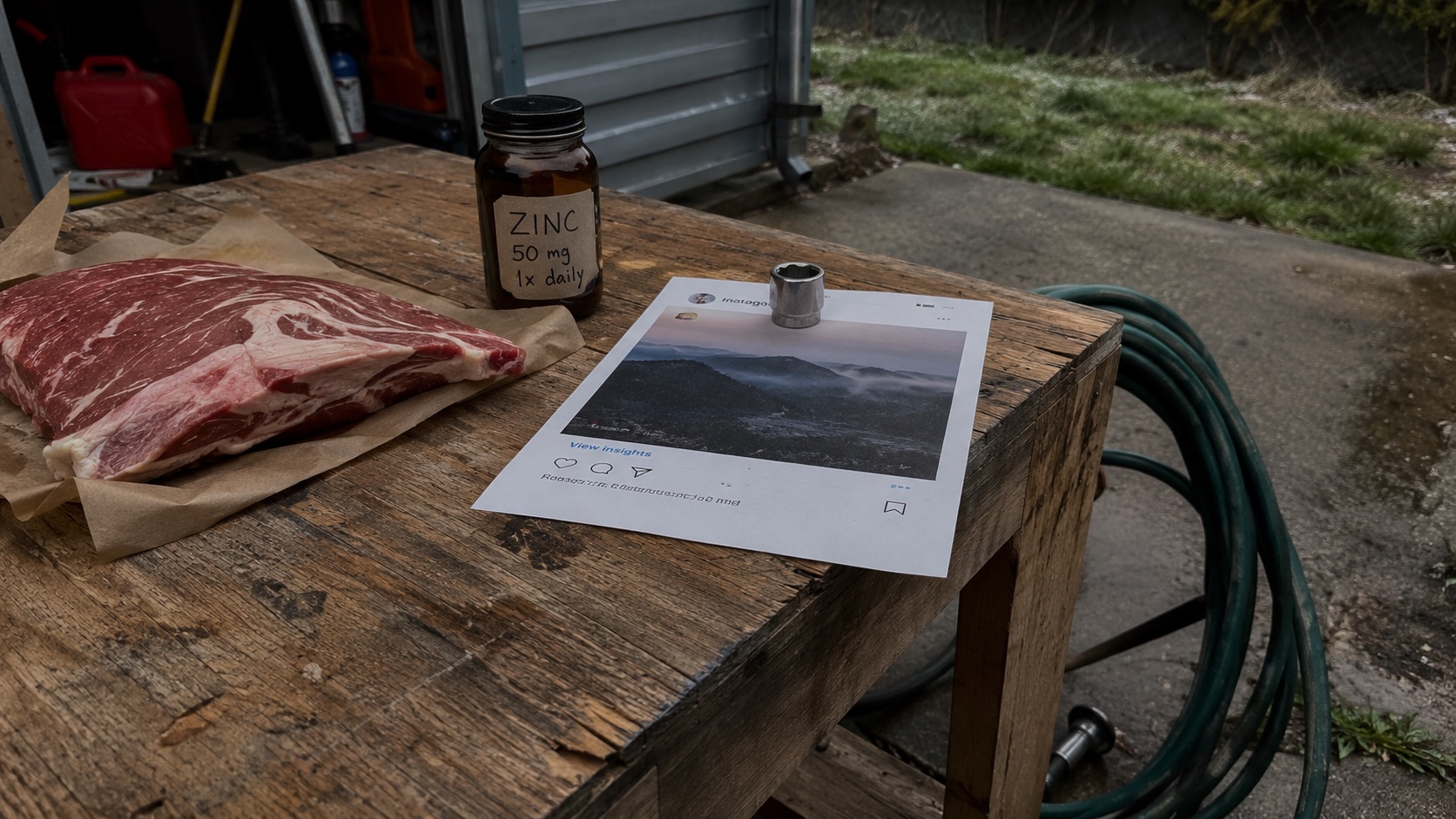
Somewhere on Instagram right now, a guy with “Dr.” in his bio is telling you that seed oils are slowly killing you, that your ancestral lineage demands you eat raw beef liver, and that for $197 a month he’ll coach you through the transition. He probably has a good jawline. He definitely has a supplement store.
This is the carnivore grift. It’s not really about what you eat. It’s about who profits from what you eat.
The Infrastructure
A 2025 report by the Rooted Research Collective analyzed 53 high-reach Instagram accounts with a combined 24.8 million followers. The findings are not subtle. Eighty-seven percent of these accounts are not medical doctors. Fifty-nine percent have no health credential of any kind. About one in five present themselves as credentialed experts anyway. And ninety-six percent have a direct financial stake in the claims they’re making.
Full disclosure: the Rooted Research Collective is affiliated with a pro-plant-based advocacy group. That’s worth knowing. But the numbers they found don’t require a particular ideology to be damning. A platform full of unqualified people selling medical advice while calling themselves doctors is a problem regardless of what you think about beef.
The business model is predictable once you see it. First comes the content: the fear, the outrage, the viral post blaming your fatigue on “toxic plants” and “industrial seed oils.” Then comes the coaching upsell, typically $100 to $250 an hour. Then the supplement affiliate deal, the discount code, the sponsored post that looks exactly like all the other posts. Some of these accounts run full-on “medical conferences.” The top earners pull in over $100,000 a month from social media alone.
It’s a system. The diet is almost incidental to the money.
The Mascot
Nobody embodied this machine more completely than Brian Johnson, the man who called himself the Liver King. He spent years building a brand around what he called “ancestral tenets”: eat raw organs, get cold, get sun, fight. His supplement company, Ancestral Supplements, reportedly cleared over $100 million in annual revenue at its peak.
He also swore, repeatedly and publicly, that his physique was completely natural.
In November 2022, a fitness YouTuber leaked emails and blood tests showing Johnson was spending roughly $11,000 a month on steroids and human growth hormone. Johnson admitted it. Netflix documented the whole thing in a 2025 documentary, and somehow, in the film, he still injects something on camera.
As of 2025, he still has nearly nine million combined followers across TikTok and Instagram.
The lesson from the Liver King is not that raw liver is poison. It’s that the persona is the product, the confession is part of the brand, and the audience largely stays anyway.
The Medical Part
The carnivore diet does have a real medical concern attached to it, and it deserves an honest look.
Clinical case reports have documented otherwise healthy young men developing LDL cholesterol levels exceeding 580 mg/dL after a year on a strict carnivore diet. That’s the range you’d normally see in people with a rare genetic disorder called familial hypercholesterolemia. In these cases, there was no genetic mutation. The diet was doing it.
Elevated LDL is an established cardiovascular risk factor. That is not contested. What is genuinely contested is whether LDL particle size changes the risk calculation, since some research suggests large LDL particles are less harmful than small, dense ones. The science here is legitimately complex, and the honest version of this post doesn’t paper over that.
What is not complex is this: there are no long-term randomized controlled trials on the carnivore diet. A 2026 scoping review found only nine qualifying studies, most of which lacked control groups and relied on self-reported data. The influencers making definitive claims about what will happen to your body over a decade are not working from evidence. They’re working from confidence, which they’ve learned to package and sell very effectively.
The Real Problem
Here’s the part that’s easy to miss. The people following these accounts are not stupid. Most of them are trying to feel better, lose weight, fix a chronic problem that conventional medicine hasn’t solved. Those are legitimate motivations. The frustration that leads someone to a carnivore influencer is often completely understandable.
The grift works by meeting that frustration with a simple story: the mainstream lied to you, we have the real answer, here’s what to buy. It’s the oldest sales structure in the world. They just updated the aesthetics. Now it comes with a shirtless guy eating a raw testicle instead of a guy in a lab coat holding a bottle of snake oil.
The diet itself might give some people short-term results. A lot of restrictive diets do, for a lot of different reasons, and the absence of long-term data cuts both ways. But the people selling it as a cure-all, stacking up fake credentials and supplement commissions while they do it, are not your doctors. They’re not your friends. They’re running a business, and you’re the customer.
References
- Millbank, A., et al. Nutrition Misinformation in the Digital Age (2024-2025). Rooted Research Collective / Freedom Food Alliance — https://rootedresearch.co/publications/nutrition-misinformation-digital-age/
- Faunalytics summary of Rooted Research Collective report — https://faunalytics.org/how-instagram-influencers-spread-nutrition-misinformation/
- “Untold: The Liver King.” Wikipedia — https://en.wikipedia.org/wiki/Untold:_The_Liver_King
- The True Story Behind Netflix’s ‘Untold: The Liver King.’ Time — https://time.com/7284988/untold-the-liver-king-true-story-netflix/
- 5 Things We Learned From Netflix’s ‘Untold: The Liver King.’ Rolling Stone — https://www.rollingstone.com/culture/culture-features/liver-king-netflix-documentary-steroids-ancestral-lifestyle-1235338458/
- The Carnivore Diet Conundrum. Med CPD — https://medcpd.com/the-carnivore-diet-conundrum/
- Association of a Low-Carbohydrate High-Fat Diet With Plasma Lipid Levels and Cardiovascular Risk. PMC — https://pmc.ncbi.nlm.nih.gov/articles/PMC11287001/
- Lowering LDL cholesterol reduces cardiovascular risk independently of presence of inflammation. PMC — https://www.ncbi.nlm.nih.gov/pmc/articles/PMC5978933/
- Research Review: The Carnivore Diet — Short-Term Gains, Long-Term Unknowns. Mountain Tactical Institute — https://mtntactical.com/knowledge/research-review-the-carnivore-diet-short-term-gains-long-term-unknowns/