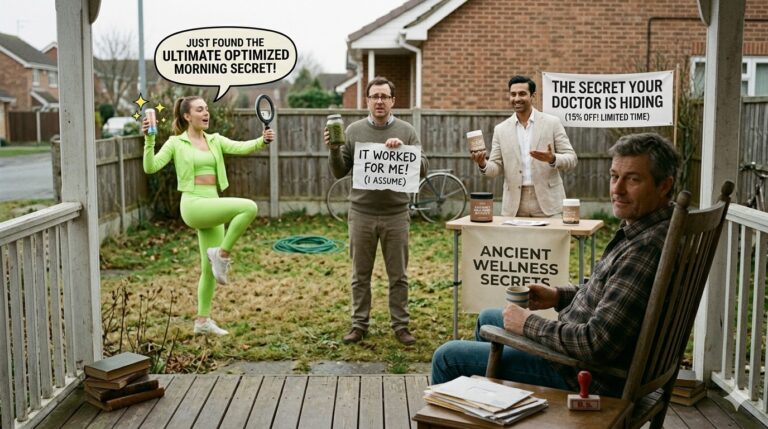
This isn't about being a cynic. It’s about being a skeptic.
The Fear Merchant’s Playbook

Back in the day, if a guy wanted to sell you a miracle tonic, he had to stand on a literal wooden crate and shout at people passing by. If the tonic didn’t work, or made your hair fall out, he had to skip town before the locals caught up with him. There was a built-in accountability system. It was called consequences.
Now, he just needs a ring light and a Wi-Fi connection.
The script these modern fear merchants follow is remarkably consistent. First, they identify something ordinary that you use every day: seed oil, tap water, sunscreen, your microwave. Then they tell you it is slowly killing you, that it is a “poison” designed by a shadowy “them” to keep you weak and sick. They use words like “inflammatory,” “bioavailable,” and “toxic load” to signal expertise they don’t actually have. The only thing they are genuinely expert in is your amygdala. That’s the part of your brain that handles fear, and research confirms it is the engine that powers their entire business model. [1]
Here is how the playbook works, step by step.
The Setup: Manufacturing the Crisis
The fear merchant needs a villain. Something familiar enough that you already use it, obscure enough that you haven’t thought hard about it. Seed oils are the current favorite.
The claim you’ll hear is that canola oil is “industrial lubricant” repurposed as food. Here’s the actual history. Rapeseed oil, the ancestor of canola, was used as an industrial lubricant during World War II because it clung well to wet metal in steam engines. After the war, Canadian scientists spent decades selectively breeding a new, low-erucic-acid variety specifically safe for human consumption. They called it canola, an abbreviation of “Canadian oil, low acid.” It was a purpose-built food crop. The FDA recognized canola oil as generally safe, and in 2006 issued a qualified health claim for its role in reducing coronary heart disease risk. [2]
The “industrial lubricant” line is a classic half-truth. It takes a real piece of history, strips out every relevant detail, and lets the fear do the rest. Boring and accurate doesn’t get clicks. Terrifying and oversimplified does.
As for the broader claim that seed oils are toxic: Harvard, Stanford, Memorial Sloan Kettering, and the American Heart Association have all reviewed the peer-reviewed literature and landed in the same place. Seed oils, consumed in normal dietary amounts, are not only safe but associated with lower rates of cardiovascular disease. A 2025 study published in JAMA Internal Medicine found that people with the highest seed oil consumption were 16% less likely to die than those with the lowest. [3] That’s not a result you’d expect from an industrial lubricant.
The Hook: The Secret Knowledge
Once the villain is established, the fear merchant positions himself as the only person brave enough to tell you the truth that doctors and scientists are supposedly hiding. It’s a masterful move, and it works because of how our brains are wired.
When the amygdala registers a threat, it can literally short-circuit the rational prefrontal cortex. Fear responses are faster than logical analysis by design. That’s an evolutionary feature, not a flaw. It kept our ancestors alive. But it also makes us vulnerable to anyone who knows how to trigger it on purpose. When someone says “they don’t want you to know this,” your fear response activates before your skepticism has a chance to wake up. [1]
The “secret knowledge” framing also hands the follower something valuable: identity. Believing you’ve seen through the official narrative makes you feel smart. It makes you part of a group. I grew up in a world where “secret knowledge” meant your neighbor knew a guy who could fix a transmission for fifty bucks. Now it means someone with a gym membership and good lighting is telling you that dermatologists and cardiologists are in on a global health conspiracy.
The Close: The Supplement Solution
After the fear merchant has you convinced that your pantry is a crime scene, he reveals the solution. And wouldn’t you know it, he just happens to have formulated a “natural” supplement that addresses the very toxins he spent the last ten minutes inventing.
It’s a closed loop. The same person who manufactures the problem sells the cure. He breaks your leg and then offers to sell you a gold-plated crutch.
This is not an accident. It is the business model. Fear-based marketing is specifically designed to activate loss aversion, the well-documented psychological principle that the pain of losing something feels about twice as powerful as the pleasure of gaining something equivalent. If you can make someone believe their health is already slipping away, they will pay to stop that loss. The supplement doesn’t need to work. It just needs to arrive before the fear wears off. [4]
How to Spot It
The playbook is consistent enough that you can learn to recognize it in real time. A few things to look for: Does the person identify a common, everyday item as a hidden threat? Do they claim that mainstream science or medicine is concealing the truth? Do they follow the warning with a product for sale? If the answer to all three is yes, you are looking at a fear merchant, not a health advocate.
Being skeptical of this stuff isn’t cynicism. It’s just paying attention. The snake oil salesman has always been with us. He just upgraded his wooden crate to a content studio and his miracle tonic to a subscription supplement box.
The garden hose is still free. Nobody’s trying to sell you a monthly plan to use it.