This isn't about being a cynic. It’s about being a skeptic.
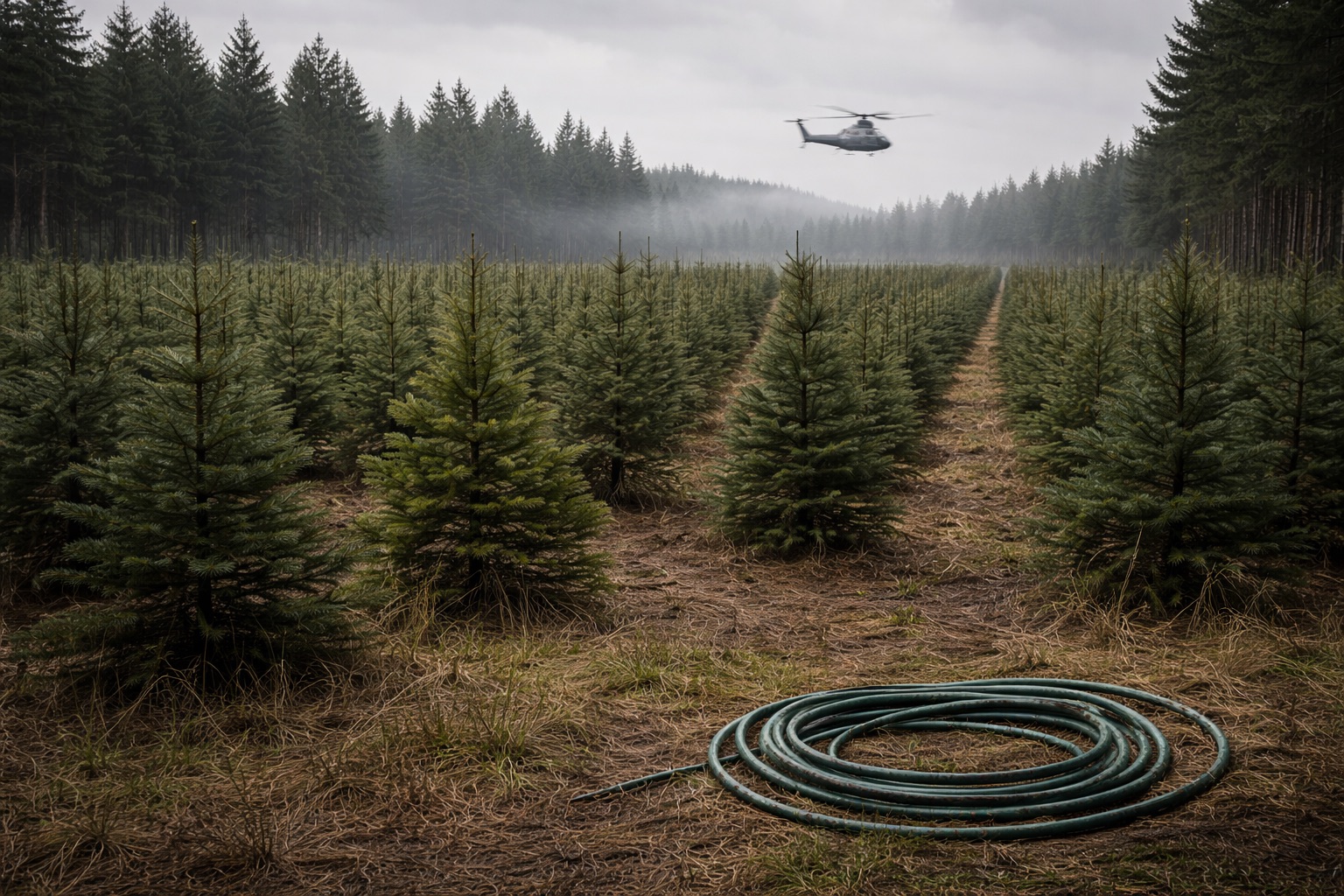
They’re Spraying Roundup on Your National Forests

If you saw this going around on social media recently and assumed it was another chemtrail-adjacent fever dream, I understand. So did I. Then I looked it up.
It’s real. The U.S. Forest Service and timber companies partnered with it have been spraying Roundup, the glyphosate-based weed killer made by Bayer, on thousands of acres of national forests. A journalist named Nate Halverson spent a year on this for Mother Jones, analyzing more than five million California pesticide records going back to 1990. What he found was not a conspiracy. It was a business decision.1
This Isn’t About Weeds. It’s About Lumber.
The Forest Service has a name for what they’re doing. They call it “conifer release.”2 Here’s how it works. After a clear-cut or a wildfire, you’ve got an open landscape. Broadleaf trees, native shrubs, wildflowers, and other deciduous plants start to grow back first. They’re fast. They compete with young conifers for water, sunlight, and nutrients. If you want pine and cedar to dominate, you have to get rid of the competition.
You can do that by hand. People used to. It takes time and it costs money. According to the Mother Jones report, manual conifer release can run three times the cost of aerial herbicide spraying.3
So instead, they spray Roundup from helicopters. The deciduous plants die. The young conifers survive because their needles can tolerate glyphosate, at least in dormancy. You get a forest of tightly packed conifer saplings, ready for the next harvest cycle. No bees. No wildflowers. No nothing. Just rows of commercially valuable trees, grown the same way you’d grow corn.
This practice has been going on for decades. Weyerhaeuser was using glyphosate for conifer release as far back as 1979.4 The Forest Service has been doing it on public land too, with the stated justification that it controls invasive species and supports forest recovery. In California alone, glyphosate use in forests reached about 266,000 pounds in 2023. That’s roughly five times the amount used twenty years earlier.1
And under the current administration, the numbers are going up. Trump invoked the Defense Production Act in February to boost domestic glyphosate production and extend legal immunity to herbicide manufacturers.5
The Cancer Question Is Genuinely Complicated
Here’s where I’m going to slow down, because this is where the honest answer gets messy.
The World Health Organization’s cancer research arm, the IARC, classified glyphosate as a “probable carcinogen” in 2015, primarily linking it to non-Hodgkin lymphoma.6 Bayer, which acquired Roundup maker Monsanto in 2018, disputes this. So does the U.S. EPA, which concluded that glyphosate is “not likely to be carcinogenic to humans.” Most other major regulatory bodies worldwide, including agencies in Canada, Australia, Europe, and Japan, reached similar conclusions to the EPA.7
The disagreement between the IARC and everyone else comes down to methodology. They looked at overlapping but different sets of studies, weighted the evidence differently, and reached different conclusions. There is also a documented controversy around the IARC’s 2015 review, including reports that the panel chair withheld unpublished data from the U.S. National Cancer Institute that would have made a carcinogenic classification less likely.8 That does not make glyphosate safe. It makes the science a genuine mess.
What is not in dispute: Bayer has agreed to a proposed $7.25 billion settlement to resolve tens of thousands of lawsuits from people who developed non-Hodgkin lymphoma after exposure to Roundup. The company previously resolved an earlier wave of litigation for around $10 billion. Bayer continues to maintain the product is safe.9
You are allowed to hold both of those things in your head at the same time.
What Actually Bugs Me
The cancer science will be argued in courtrooms and journals for years. I’m not here to settle it.
What I am here to say is this: nobody told you that your national forests, which belong to you and me and everyone else in this country, are being managed like a timber plantation. That’s a decision being made primarily for economic reasons, at scale, on public land, with a chemical that is still actively under litigation over human health effects.
The Forest Service says it relies on the EPA to evaluate herbicide safety. The EPA’s evaluation is, as of right now, being reconsidered. Meanwhile, a Ninth Circuit court has already ordered the EPA to revisit its conclusion.10
The people who grow up near these forests, the ones hiking through them, the workers doing the spraying, the fish living downstream from the runoff: none of them had a meeting about this. A helicopter just showed up one day and the wildflowers were gone.
When the government uses a contested chemical on your public land to make it easier to harvest timber, and the whole thing quietly goes on for decades before a journalist spends a year digging it up, that’s worth knowing. That’s not a conspiracy theory. That’s just the news.
References
- Forest Service, timber companies are spraying weedkiller glyphosate on forests | Snopes ↩
- Trump’s US Forest Service Spraying Roundup on America’s Woodlands | Futurism ↩
- Trump’s US Forest Service Spraying Roundup on America’s Woodlands | Futurism ↩
- Conifer Release | Wikipedia ↩
- Trump’s US Forest Service Spraying Roundup on America’s Woodlands | Futurism ↩
- Does Roundup Cause Cancer? | Texas A&M School of Public Health ↩
- Glyphosate | U.S. EPA ↩
- IARC Glyphosate Determination Challenged by World Consensus | Genetic Literacy Project ↩
- Bayer agrees to $7.25 billion proposed settlement over Roundup cancer lawsuits | STAT News ↩
- Ninth Circuit Orders EPA to Revisit Glyphosate Cancer Conclusion | National Agricultural Law Center ↩